The basic number tells you the size. Everything after it tells you what kind of bearing it actually is.
A 6205, a 6205-2RS and a 6205-2RS-C3 all fit the same 25 mm shaft and the same 52 mm housing bore. They are not interchangeable in service. Fit the wrong one and the bearing may run hot, let water in, or seize on a shaft it was never meant to clamp onto.
This guide covers the bearing suffixes you’ll meet most often, how the main brands write them differently, and which swaps are safe when you can’t get the exact one.
Seals and shields
The most common suffixes, and the ones that matter most in a dirty or wet plant.
| What you have | Common codes | Behaviour |
|---|---|---|
| Open, no protection | no suffix | Lowest friction, highest speed, no protection |
| One metal shield | Z, ZN | Non-contact, keeps out coarse dust |
| Two metal shields | ZZ, 2Z | Same, both sides |
| One rubber seal | RS, RSR | Contact seal, fine dust and moisture |
| Two rubber seals | 2RS, 2RSR, DDU, LLU | Same, both sides |
| Two low-friction seals | 2RZ, RSL, LLB | Light contact, between a shield and a full seal |
Here’s where brands diverge. The same double rubber-sealed bearing is written:
- 2RS1 or 2RSH by SKF
- 2RSR by FAG
- DDU by NSK
- LLU by NTN
- 2RS or 2RD by Koyo
- 2NSE by NACHI
They’re equivalent in function, though seal materials and the exact lip design differ. If you’re switching makes, treat them as equivalent for selection purposes and check the temperature rating if the position runs hot, because standard nitrile seals have a lower limit than the bearing itself.
The shield-versus-seal decision, in one line each:
- Shields add almost no friction and barely affect maximum speed, but they don’t stop water or fine dust.
- Seals stop both, at the cost of friction, running temperature and speed. They’re also greased for life, so you can’t relubricate through them.
Internal clearance
The second group that causes real trouble.
Internal clearance is the small amount of free movement inside an unmounted bearing. It sounds like slack, but it’s there so the bearing still has working clearance once it’s been pressed onto a shaft and has warmed up.
| Code | Clearance |
|---|---|
| C1, C2 | Less than normal |
| CN (or no code) | Normal |
| C3 | Greater than normal |
| C4, C5 | Greater again |
When you need more than normal:
- a tight interference fit on the shaft, which squeezes the inner ring and reduces clearance
- the bearing running hot, so the inner ring expands more than the outer
- some misalignment present
- heavy vibration
When you want less: positions needing precise location with minimal shaft movement.
The practical rule: if the old bearing was C3, fit C3. Substituting a normal-clearance bearing into a position specified as C3 is one of the more common causes of a replacement running hot within hours. Electric motors in particular are frequently C3 as standard.
Bore shape: the K suffix
A K after the number means a tapered bore, usually 1:12. These don’t go straight onto a plain shaft. They mount either on a tapered shaft seat or, far more often, on an adapter sleeve with a locknut.
Two things follow from that:
- K and non-K are not interchangeable. A K bearing on a plain shaft has nothing clamping it.
- The nut setting controls the clearance. Driving the bearing up the taper squeezes the inner ring and reduces internal clearance, which is why K bearings are usually specified C3 or C4. Tighten by the figure for the size, not by feel.
K30 indicates a 1:30 taper, used on some larger spherical roller bearings. It is not interchangeable with 1:12.
You’ll see K most often on self-aligning and spherical bearings, where sleeve mounting is standard in the larger sizes.
Internal design: E, EC, CA, CC
These indicate a modified internal design, usually meaning more or larger rolling elements and therefore higher load capacity than the older design of the same size.
- E or EC: reinforced design. Common on cylindrical roller and self-aligning bearings.
- CA, CC, CAC: cage and guidance variants on spherical roller bearings. CC generally indicates a pressed-steel cage with a guide ring; CA indicates a machined brass cage.
An E-design bearing is dimensionally the same as the non-E version, so it fits the same housing. In most cases it’s an upgrade, though check with the maker where preload or speed is critical.
Cages
- J: pressed-steel cage, the usual default
- M, MA, MB: machined brass cage, used at higher speeds, higher temperatures or under heavy vibration. MA and MB differ in whether the cage is guided by the outer or inner ring.
- TN9, TNG, TVH: moulded polyamide cage. Quiet and light, but with a temperature ceiling, typically around 120°C, and vulnerable to ageing in some oils.
- W33: an annular groove and three lubrication holes in the outer ring, letting grease reach the bearing through the housing. Common on spherical rollers in positions that are relubricated in service.
The cage is where a substitution can quietly go wrong. Swapping a brass-cage bearing for a polyamide one in a hot position will shorten its life, even though the bearing number otherwise matches.
Heat stabilisation: S0 to S4
Standard bearings are dimensionally stable to about 120°C. Above that, the rings can change size in service. Heat-stabilised bearings carry an S code indicating the temperature they’re stable to, rising through S0, S1, S2, S3 and S4.
If a position runs hot enough to need this, it usually also needs the right grease and greater clearance. The combination matters more than any one element. Our high temperature bearings page sets out the S codes against temperature.
Precision classes
P0 is normal, and P6, P5, P4 and P2 tighten progressively on running and dimensional accuracy. Standard industrial positions run fine on P0. Spindles, grinding machines and anything where runout shows in the finished product usually need P5 or better.
Paying for a class the application doesn’t need gains nothing. Specifying below what it needs shows up in the work.
Pairing and preload codes
On angular contact bearings you’ll see arrangement suffixes: DB back to back, DF face to face, DT tandem. These usually come with a preload class, light, medium or heavy, written differently by each maker.
Two bearings of the same number are not a matched pair. If the position needs one, order it as a set and say so.
Reading a full designation
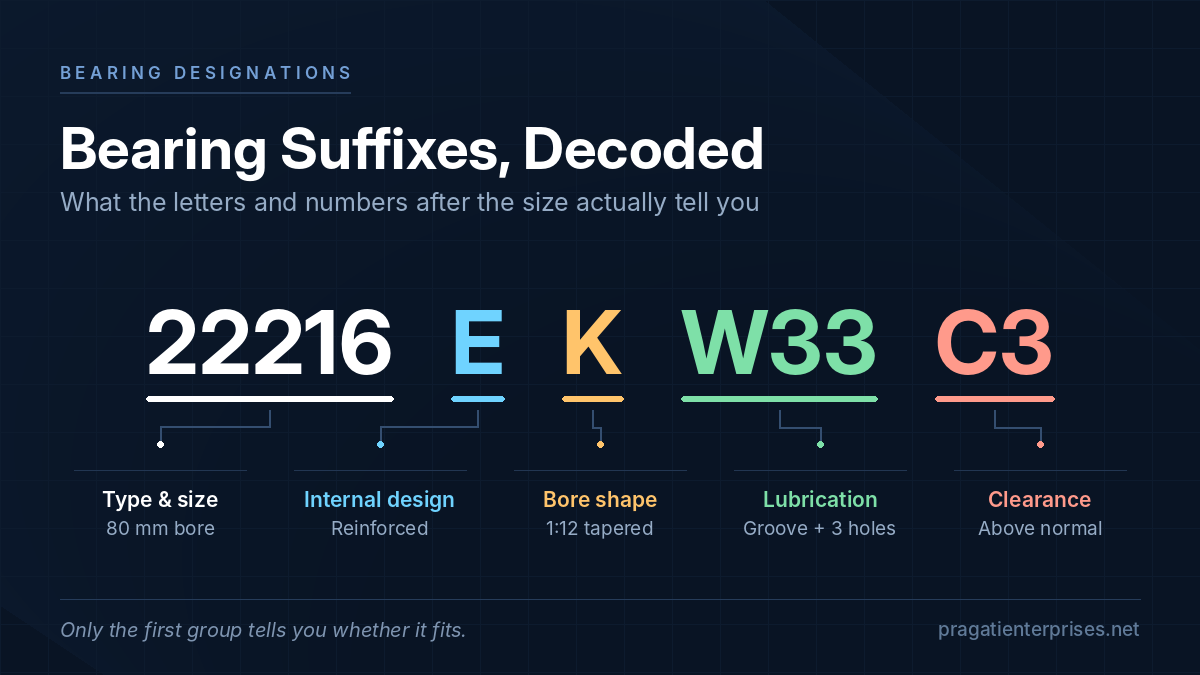
Take 22216 EK W33 C3:
- 22216 — spherical roller bearing, 222 series, 80 mm bore
- E — reinforced internal design
- K — 1:12 tapered bore, for sleeve mounting
- W33 — lubrication groove and holes in the outer ring
- C3 — greater than normal internal clearance
Every one of those affects whether the bearing is right for the position. Only the first group tells you whether it fits.
Which substitutions are safe
Usually safe:
- a brand’s equivalent seal code for the same construction (2RS1 for DDU for LLU)
- an E-design bearing in place of the older design of the same number
- a higher precision class than specified, where the cost is acceptable
Usually not safe:
- normal clearance in place of C3, or the reverse
- a shielded bearing (ZZ) where the original was sealed (2RS), in a wet or dusty position
- K for non-K, in either direction
- polyamide cage in place of brass in a hot position
- one angular contact bearing in place of a matched pair
Needs checking: a sealed bearing in place of an open one at high speed, since the seal lowers the speed limit.
When the suffix has worn off
If you can read the basic number but not the suffix, work from the application:
- Was the old bearing sealed, shielded or open? Look at the bearing itself.
- Does the position run hot, or is the shaft fit tight? That points to C3.
- Is it on an adapter sleeve? Then it’s a K bore.
- Is the housing drilled for grease into the outer ring? That suggests W33.
The dimensions tell you the basic number, and our bearing size chart covers that. The old bearing itself tells you most of the rest.
FAQs
What’s the difference between 2RS and ZZ?
2RS has rubber contact seals on both sides, which keep out fine dust and moisture but add friction and lower the speed limit. ZZ has metal shields that don’t touch the inner ring, so friction stays low but protection is limited to coarse dust.
What does C3 mean, and do I need it?
C3 is greater than normal internal clearance. It’s needed where the bearing runs hot, has a tight shaft fit, or is in a position specified for it, such as many electric motors. If the old bearing was C3, fit C3.
Is 2RS1 the same as DDU?
Functionally yes. They’re the SKF and NSK codes for a double rubber-sealed bearing. Seal materials and lip design vary slightly, so check the temperature rating if the position runs hot.
Can I fit a K bearing on a straight shaft?
No. A K bearing has a tapered bore and needs either a tapered shaft seat or an adapter sleeve with a locknut to clamp it.